




Are you also comparing your toddler’s babbling with other babies of their age?
Then you are not alone. Most parents do that. They Google, watch, and wait to understand things just to reassure themselves that their baby is also developing, might not be as advanced as others, but they are doing well.
Searching “Why my child is not talking clearly”, “Speech Delay in children is common”, “Why my child is not talking yet”, “Why my 2-year-old is not talking clearly”, and many more is not going to solve your problem. Instead, it is better to understand why it is happening.
But here is the truth: every child is not similar, and not every child who talks a little later has a problem. But sometimes, speech delay can actually be a problem rather than just a phase, and the only solution is an expert.
As a parent, you should get clarity about speech delay in children, when to worry, what speech therapy is, and how speech therapy helps. That is why, at Cradle Children Hospital, we clarify everything to parents, starting from normal speech development at each age, red flags that actually need a professional opinion, and how speech therapy is an actual treatment. So, rather than worrying, start understanding everything.
What is Speech Delay in Children?
As per pediatricians, toddlers develop certain skills as per their age. But when a child does not develop speech skills as they should, as per their age. It is common that some children build skills a little delayed and progress differently, but it is essential to differentiate between normal and serious delay, and also speech and language delay.
Speech delay development in children happens when they have difficulty forming words and sounds, while language delay is when they have difficulty in understanding or using language.
Speech Milestones As Per Age
As per the National Institute on Deafness and Other Communication Disorders, not every child develops speech skills as per the timetable. But if you suspect that your child is falling behind and showing some signs which is indicating speech delay, talk to Cradle Children Hospital’s expert, who can provide you a legit information. Until then, the speech milestones below by age will help you understand what skills your child develops as per age.
Birth to 3 Months
- Makes sounds like aah, ooh, and mmm back and forth
- Tries to look towards the voices or noise
- Cries differently for different needs like hunger or discomfort
- Recognizes parents’ voice, especially mothers
4 to 6 months
- Laughs and squeals
- Starts to babble with sounds like ga, ba, ma
- Turns towards voice and sound
- Responds to changes in tone of voice
7 to 12 months
- Responds to their own name
- Babbles long strings of sounds like mama or baba
- Some can say words
- Understands words like bye-bye and also does gestures like waving
12 to 18 months
- Most children start to say some meaningful words
- Tries to imitate words
- Uses gestures along with words to communicate
- Able to point to people or objects which are familiar to them
18 to 24 months
- Vocabulary grows from 5 words to more words
- Follows simple two-step directions
- Speech is understood by familiar people about 50% of the time
- Names familiar people and objects too
- Begins combining two words
2 to 3 years
- Asks questions such as “What is that?”
- Uses pronouns such as “I, me, you”
- Short sentences (2-4 words)
- Able to communicate with familiar people 75% of the time
- Vocabulary of 200-500 words
3 to 5 years
- Makes sentences (4-8+ words)
- Able to answer “who, what, where, and why” questions
- Tells stories or events
- Grammar used most of the time correctly
- Able to communicate with unfamiliar people 99.9% of the time by age 4-5
Red Flags that Parents Need to Understand
There are some red flags that parents should know, and if your child is showing these signs, then you should not wait, thinking, “my child will learn in a later stage”.
- Even at 12 months, they are not babbling words like mama, baba, or anything similar to these.
- Unable to frame two-word phrases by 24 months
- Little to no eye contact and also not showing gestures to communicate
- Not responding to name of themselves or the people who are always around them
- Difficulty in understanding familiar words or family members past age 3
- Unclear or unusual speech patterns
- Not playing with other children
- Limited interaction with others
- Unable to make meaningful words by 16 months
If your child starts to show two or more signs, then it is a reason to consult a pediatrician so that, as per the symptoms, they can treat your child using speech therapy. Make sure you don’t wait for the next milestone to know whether they are actually able to do it or not; seek medical guidance.
Important note to parents-
Yes, speech delay is a sign of autism, but it does not ensure that. Speech delay issues only define the problem when they don’t have strong verbal and non-verbal communication skills. But in autism, not just speech delay, but children also show signs of behavioural, social, and communication challenges.
How Does Speech Therapy Help?
- Speech therapy for children does not involve training the child to talk in a particular way. The lessons of speech therapy are fun and organized in a completely naturalistic way, and they take place through the means of games, storytelling, sound imitation, repetition while playing, and learning new things at a pace they are comfortable with.
- First of all, an experienced speech and language therapist would evaluate the current development level of speech and language in comparison with that of peers and develop a treatment plan, considering what objectives have to be achieved, whether it is vocabulary building, pronouncing particular sounds, constructing longer sentences, or teaching how to start communication.
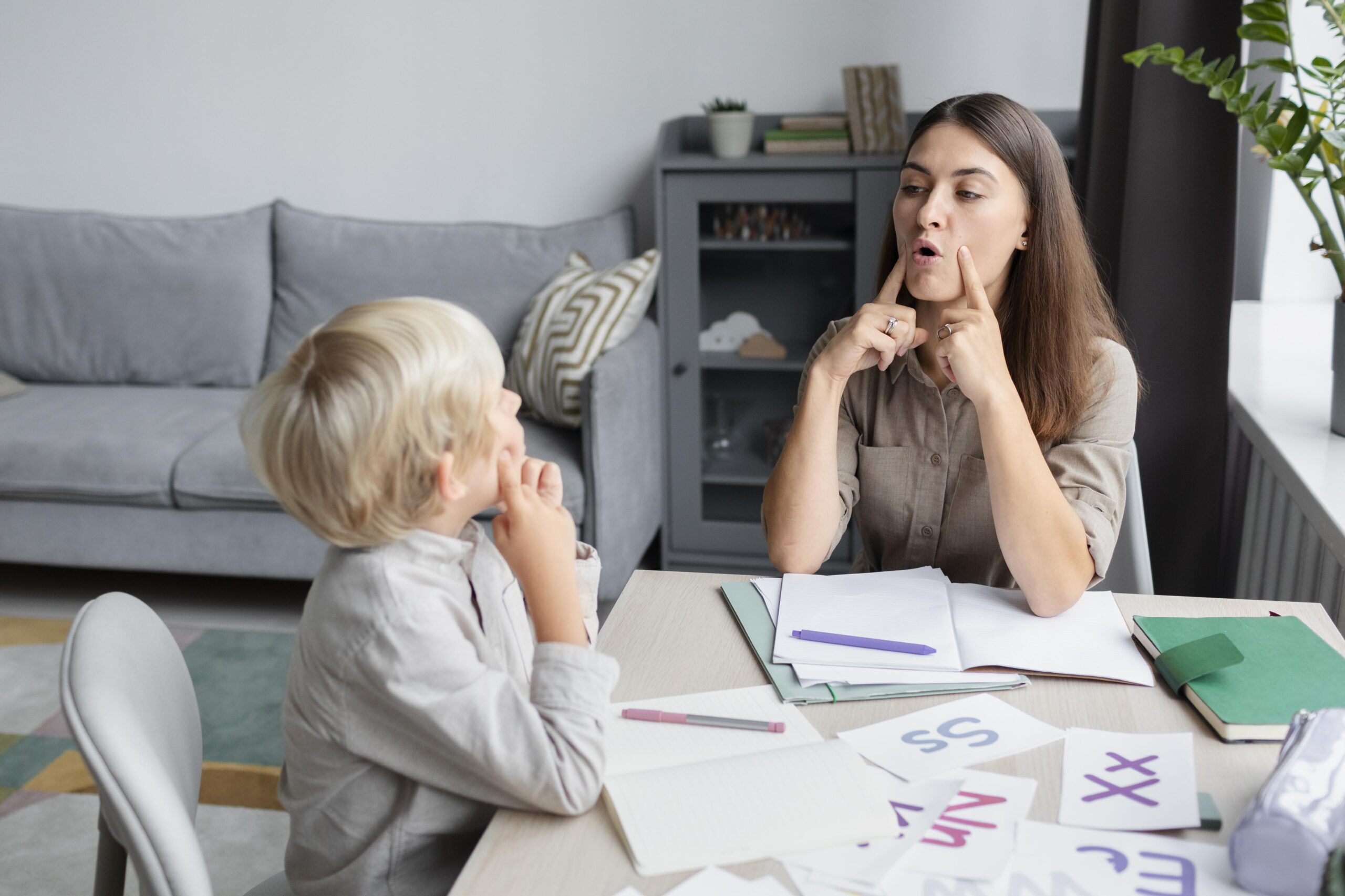
- The lesson of speech therapy for a small child may consist of a game like blowing bubbles for breathing technique improvement, naming objects in books, producing animal sounds, or incorporating such activities as eating and bathing to encourage language practice. For children with problems with articulation, speech therapy may be conducted with a focus on some particular sounds and use of mirror and kinesthetic techniques; it includes DTTC (dynamic temporal and tactile cueing), hand-to-mouth gestures, resistive jaw and lip exercises, and many more.
- This is so because speech therapy for children is highly effective if what is learned during the speech therapy session is applied in the real world in the family environment. An efficient speech therapist normally provides particular instructions on what to do between therapy sessions rather than general instructions like “Talk to your child.”
What Does a Speech Therapy Session Look Like in the CDC?
Nonetheless, one should note that taking your toddler to the hospital is not an easy task, because they are already not in a calm phase. Therefore, speech therapy sessions for toddlers in the hospital are planned in such a way that the child feels comfortable.
Firstly, Cradle Children Hospital conducts a very detailed consultation with the parents regarding the child’s development, vocabulary, behavior, and other worries about him or her. Secondly, we evaluate the child’s speech abilities, speech comprehension ability, and social behavior in a comfortable room filled with toys.
Depending on the results of this evaluation, pediatritian develop the therapy plan for your child, which is discussed with you, and your expectations regarding your child’s improvement are clarified.
In the process of therapy, we will offer age-appropriate activities and different types of exercises, including picture naming, storytelling, imitation, and so on.
Continuous monitoring and evaluation are conducted, which means there will be ongoing changes to the program as your baby grows. We also ensure that you are part of the monitoring and evaluation process regarding the development of your baby.
Here at Cradle Children Hospital, we provide individualized treatment to our patients in a way that is highly customized for each one of them. For example, we provide different treatment to a shy toddler who needs extra motivation to talk than a child who has problems with speech articulation.
Conclusion
Watching your child not develop speech skills like others is a challenging phase for parents. Especially when there is a lot of information available online. But the first thing that you need is to not panic, instead start noticing where they are lacking. And if you are noticing symptoms, then don’t delay noticing more issues. Pediatricians at Cradle Children Hospital have expertise in speech therapy for kids. They understand, evaluate, and treat kids as per their individual requirements. Because speech therapy is not about putting pressure on your child to just learn, it is also about making them understand its importance.
For expert district speech therapy in Jaipur, make sure to consult a specialist at Cradle Children Hospital. Book an appointment for your child’s speech evaluation today, and take the first step.
FAQ’s
At what age should I be concerned about my child’s speech delay?
Till their 1st birthday, children are usually able to babble some words, but if your child is unable to say some meaningful words by the time they are 16 months old, then it is time for a professional opinion.
Is speech delay a sign of autism?
Sometimes it can be, but you cannot conclude that your child has autism if they are facing challenges related to speaking skills. Yes, but if they also have behavioural and social issues along with speech delay, then this is a sign of autism spectrum disorder.
How long does speech therapy take to resolve the problem?
It depends on the child and their underlying challenges. However, parents may start to see changes within one or two months of speech therapy.
At what age do speech development issues become noticeable?
Between 12 and 24 months, your child might develop the issues. And if they are not even uttering a single word by 16 months, then it is a red flag.
What are the long-term impacts of not treating the problem on time?
If the problem is not treated on time, then it will impact your child in the future, and they will not be able to adapt, learn language, and social skills like others.